Tipo de publicação
Artigo
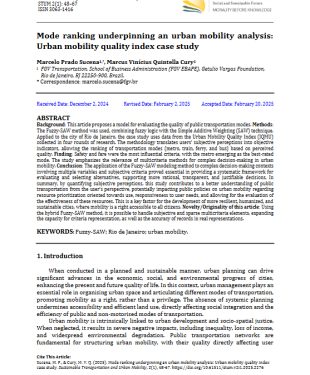
This article proposes a model for evaluating the quality of public transportation modes. Methods: The Fuzzy-SAW method was used, combining fuzzy logic with the Simple Additive Weighting (SAW) technique. Applied to the city of Rio de Janeiro, the case study uses data from the Urban Mobility Quality Index (IQMU) collected in four rounds of research. The methodology translates users' subjective perceptions into objective indicators, allowing the ranking of transportation modes (metro, train, ferry, and bus) based on perceived quality. Finding: Safety and fare were the most influential criteria, with the metro emerging as the best-rated mode. The study emphasizes the relevance of multicriteria methods for complex decision-making in urban mobility. Conclusion: The application of the Fuzzy-SAW modeling method to complex decision-making contexts involving multiple variables and subjective criteria proved essential in providing a systematic framework for evaluating and selecting alternatives, supporting more rational, transparent, and justifiable decisions. In summary, by quantifying subjective perceptions, this study contributes to a better understanding of public transportation from the user's perspective, potentially impacting public policies on urban mobility regarding resource prioritization oriented towards use, responsiveness to user needs, and allowing for the evaluation of the effectiveness of these resources. This is a key factor for the development of more resilient, humanized, and sustainable cities, where mobility is a right accessible to all citizens. Novelty/Originality of this article: Using the hybrid Fuzzy-SAW method, it is possible to handle subjective and sparse multicriteria elements, expanding the capacity for criteria representation, as well as the accuracy of records in real representations.